

Screen Recorder With Webcam on Mac — Record Screen and Face Together (2026)
Recording your screen and webcam at the same time on a Mac gives tutorials, demos, and walkthroughs a personal connection that a screencast alone can't match. This guide covers every method — from free built-in tools to dedicated recorders — and the practical setup steps for lighting, framing, and audio that make the difference between amateur and polished.
Quick Answer
- Free + built-in (webcam only, no screen overlay): QuickTime Player or Photo Booth
- Easiest screen + webcam + no editing needed: Screen Charm ($79 one-time)
- Free + screen + webcam together: OBS Studio (requires setup)
For a full software comparison, see our best webcam recording software for Mac guide. For audio troubleshooting, see screen recording no sound fix.
Can You Record Screen and Webcam at the Same Time on Mac?
Yes — but the built-in macOS tools don't do it natively as a picture-in-picture overlay. Here's what each option actually supports:
| Method | Records Screen | Webcam Overlay | System Audio | Free |
|---|---|---|---|---|
| QuickTime Player | Yes | No | No | Yes |
| Photo Booth | No | Yes | No | Yes |
| Screen Charm | Yes | Yes | Yes | No ($79) |
| OBS Studio | Yes | Yes | Needs setup | Yes |
| ScreenFlow / Camtasia | Yes | Yes | Yes | No |
Best Screen Recorder With Webcam on Mac
The short answer depends on what matters most to you:
- Best free: OBS Studio — records screen and webcam simultaneously, no watermark, no limits. Requires a 30–60 minute setup.
- Easiest: Screen Charm — webcam overlay, auto-zoom, and system audio work out of the box. $79 one-time.
- Built-in macOS tools: Limited — QuickTime records webcam or screen, but not both together as picture-in-picture.
The sections below walk through each option step by step.
Option 1: Built-In Mac Tools (Webcam or Screen, Not Both)
QuickTime Player — Webcam Recording
QuickTime can record your webcam as a standalone video (not overlaid on screen):
- Open QuickTime Player
- Go to File → New Movie Recording
- Click the dropdown arrow next to the record button and select your camera and microphone
- Press the red button to record
QuickTime records at native resolution with no time limit or watermark. It cannot record system audio and cannot overlay your webcam on a screen recording simultaneously.
Photo Booth — Quick Webcam Capture
Photo Booth is simpler — open it, click Effects if you want a background, and hit record. It's best for casual, short clips. Not suitable for tutorials or demos.
The Built-In Limitation
Neither QuickTime nor the Shift + Command + 5 Screenshot toolbar can combine a screen recording with a live webcam overlay in picture-in-picture. For that, you need OBS or a dedicated recorder.
Option 2: Screen Charm — Easiest Screen + Webcam + Auto-Zoom
Screen Charm is built for Mac and handles screen + webcam in a single click with no scene setup required.
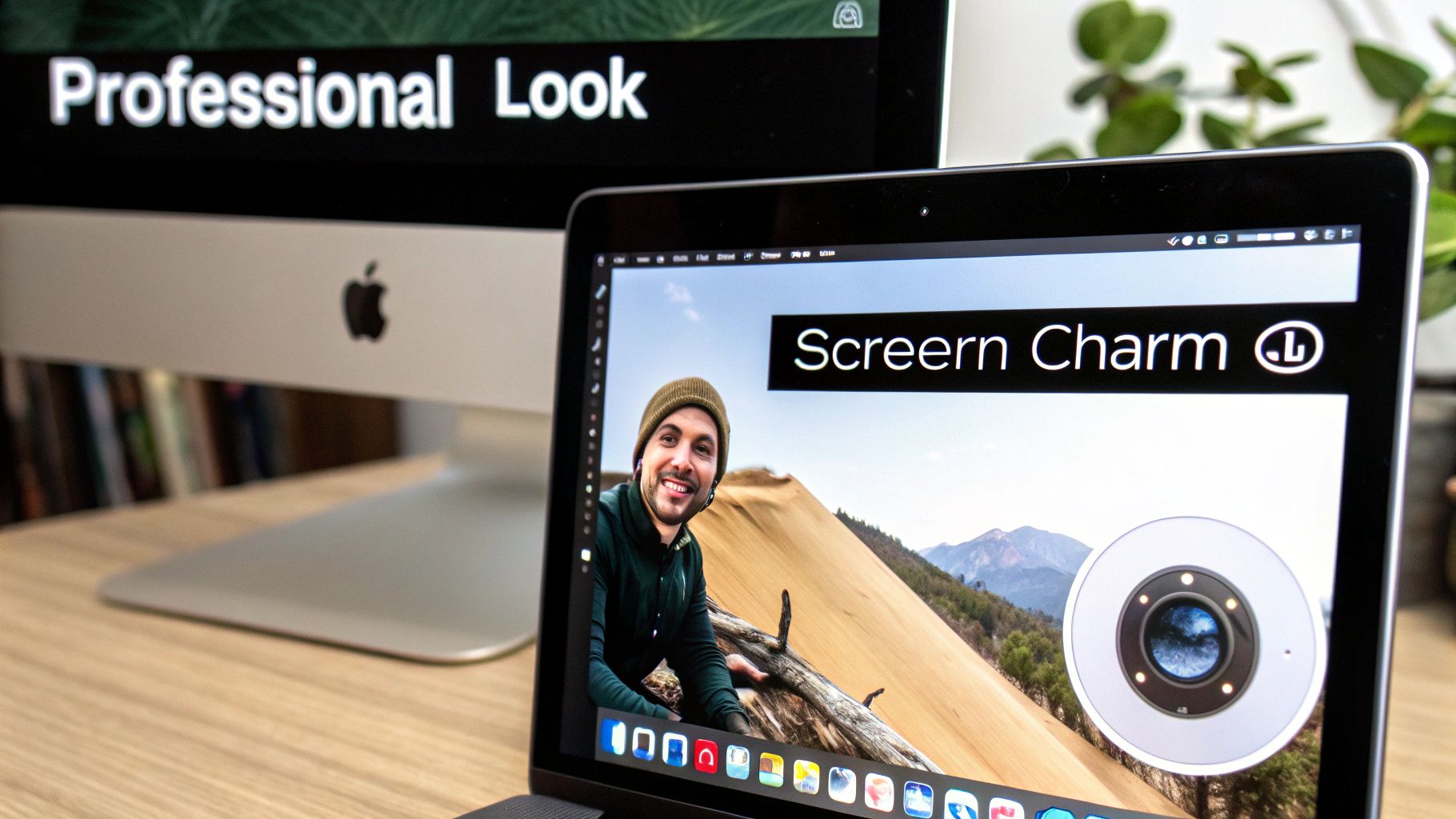
How it works:
- Open Screen Charm and choose your recording area
- Enable the webcam toggle — the overlay appears instantly, no scene setup
- Choose webcam shape (circle or square), position, and background
- Press record — screen, webcam, mic, and system audio all captured together
- In the built-in editor: trim, reposition the webcam bubble, fine-tune auto-zoom points, then export as MP4 at 1080p or 4K
The standout feature is intelligent auto-zoom: it tracks your cursor and zooms in on interface elements automatically, so your recordings look edited without manual keyframing.
Pricing: $79 one-time, lifetime updates, 14-day money-back guarantee — screencharm.com
Option 3: OBS Studio — Free Screen + Webcam Together
OBS Studio is free, has no watermark, and fully supports simultaneous screen + webcam recording on Mac.
How to set up screen + webcam in OBS:
- Download and open OBS Studio
- In the Sources panel, click + → Display Capture to add your screen
- Click + again → Video Capture Device to add your webcam
- Resize and position the webcam source in the preview — drag it to a corner
- Set your microphone under Settings → Audio
- For system audio (app sounds), install BlackHole and select it as a desktop audio source
- Press Start Recording
OBS outputs to your chosen folder in MP4 or MKV. The learning curve is real — expect 30–60 minutes to get comfortable — but once configured it's reliable and free indefinitely.
How to Record Screen, Webcam, and System Audio Together
Recording all three simultaneously — screen content, your face, and the audio playing inside apps — requires a tool that supports system audio capture. macOS blocks apps from recording internal audio by default.
| Tool | System Audio | How |
|---|---|---|
| Screen Charm | Yes (built-in) | Enabled by default |
| OBS Studio | Needs setup | Install BlackHole virtual audio driver |
| QuickTime | No | Not supported |
| ScreenFlow / Camtasia | Yes | Built-in |
For a full walkthrough of enabling internal audio on Mac, see our record internal audio on Mac guide. If your recording has no audio at all, see the screen recording no sound fix.
Facecam Placement and Shape
Where you put your webcam overlay matters. These combinations work well for different content types:
| Content Type | Facecam Shape | Position | Background |
|---|---|---|---|
| Software demo | Circle | Bottom-right | Transparent |
| Marketing video | Circle | Bottom-right | Branded image |
| Internal training | Square | Bottom-left | Stock office or blur |
| Casual tutorial | Circle | Bottom-right | Transparent or blur |
Tip: If your webcam covers an important UI element, in Screen Charm you can drag it to a new position after recording in the editor — no re-recording needed.
Pre-Flight Check Before Recording
Run this before every session:
- Camera is connected and recognised — check System Settings → Privacy & Security → Camera and toggle your app on
- Microphone is working — open System Settings → Sound → Input and speak; confirm the level meter responds
- Webcam is at eye level (prop your Mac up if needed — a stack of books works)
- Background is tidy, or a virtual background is set
- Do a 10-second test recording and play it back — check framing, audio, and that the webcam overlay is visible
Lighting, Framing, and Audio
Lighting
Natural window light facing you is free and looks great. If you record at night or in a dark room, a budget ring light behind your monitor makes an immediate difference — position it at eye level, pointing at your face.
Avoid light sources behind you (windows, lamps) — they turn you into a silhouette.
Framing
- Camera at eye level — never below (unflattering) or far above (makes you look small)
- Eyes roughly on the upper third of the frame
- A small gap above your head, not a large empty space
- Face slightly off-centre looks more natural than dead-centre
Audio
Bad audio kills a video faster than bad visuals. The Mac's built-in microphone is acceptable for FaceTime; for recordings people watch, an external USB microphone is a meaningful upgrade.
Before recording: close other apps, silence notifications, and close doors to reduce echo. Speak at your normal conversational volume — the input level meter should stay in the green zone, not hitting red.
Editing and Exporting
If using OBS: OBS outputs raw footage that needs editing in a separate app (iMovie, Final Cut Pro, DaVinci Resolve).
If using Screen Charm: The built-in editor handles the essentials:
- Trim the beginning and end
- Reposition the webcam bubble if it covers something important
- Adjust auto-zoom intensity or add manual zooms for specific moments
- Export as MP4 at 1080p or 4K
Export settings to use:
- Format: MP4 (works everywhere — YouTube, Notion, email, Slack)
- Resolution: 1080p for most purposes; 4K if the detail of your UI matters (e.g. showing fine typography or dense code)
Best Screen and Webcam Recorder for YouTube
YouTube creators need a screen + webcam recorder that handles the full workflow — clean footage, reliable audio, and easy export in the right format.
- OBS Studio — best for full creative control. Set up multiple scenes, switch between layouts, record in any resolution. Ideal if you already know OBS or want to stream and record simultaneously.
- Screen Charm — best for polished tutorials fast. Auto-zoom means your recordings look professionally edited without a timeline editor. Export directly to MP4 at 4K.
- ScreenFlow — best if you need a proper timeline editor. Suits longer videos that require cuts, B-roll, titles, and annotations before uploading.
For most tutorial and demo creators uploading to YouTube, Screen Charm or OBS covers everything needed without a separate editing step.
Frequently Asked Questions
How do I record my screen and webcam at the same time on Mac?
Use OBS Studio (free) or Screen Charm ($79). QuickTime Player cannot overlay a webcam on a screen recording — it only records one at a time. In OBS, add a Display Capture source and a Video Capture Device source. In Screen Charm, enable the webcam toggle before recording.
Can I record my webcam without screen recording on Mac?
Yes. Open QuickTime Player → File → New Movie Recording, select your camera, and press record. Photo Booth also records webcam-only video.
What is the best free screen recorder with webcam for Mac?
OBS Studio — completely free, no watermark, no recording limit. It records screen and webcam simultaneously with full audio support. The trade-off is a steeper setup compared to paid tools.
Does Screen Charm work with an external webcam?
Yes. Any USB or Thunderbolt webcam recognised by macOS will appear in Screen Charm's camera dropdown. An external webcam improves image quality noticeably over the built-in FaceTime camera on most Macs.
Can I move the webcam overlay after recording?
In Screen Charm, yes — the facecam bubble is repositionable in the editor after recording. In OBS, you set the position before recording; changing it requires re-recording or using a separate video editor.
Will recording in 4K slow down my Mac?
On Apple silicon Macs (M1/M2/M3/M4), 4K recording is smooth. On older Intel Macs, 1080p is more reliable for long sessions. Screen Charm is optimised for both.
Ready to record your screen and face together with zero setup? Screen Charm handles webcam overlay, auto-zoom, and system audio in one click. For a full comparison of webcam recording apps, see our best webcam recording software for Mac guide.